

When Gourd Art Meets Hollywood
By Carol Signore
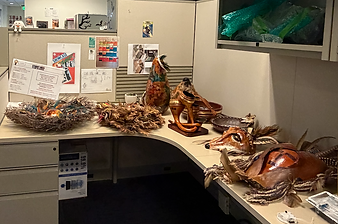
Every once in a while, gourd art opens a door you never expected. For me, that door led all the way to a television set, where my work was rented by HBO Max and Warner Bros. for use in scenes from episode 105 of the new series “Stuart Fails to Save the Universe”.
As artists, we often send our work into the world hoping it will connect with people. We imagine it displayed in homes, galleries, shows, or collections. I had not imagined seeing my gourds become part of a professionally built television environment. The experience was exciting, surprising, and a wonderful reminder that gourds have won belonging anywhere that fine art and creativity is valued.
The Unexpected Request
The process began with an inquiry about renting some of my pieces for a new production.
At first, it felt almost unreal. Television productions move quickly, and there are many
practical details involved: which pieces are available, how they will be transported, how
long they will be needed, and how they will be credited or used on set. Behind what viewers
see for just a few seconds on screen, there is a great deal of coordination.
For a gourd artist, the request was also deeply afirming. Someone connected with the
shape, texture, color, and personality of my work enough to imagine it helping tell a visual
story. That is one of the most rewarding compliments an artist can receive.
Gourds as Set Pieces
Gourd art is uniquely suited for film and television because it carries both visual impact
and a sense of handmade authenticity. A gourd is not a flat object; it has volume, shadow,
surface variation, and presence. Whether carved, burned, painted, dyed, woven, or
embellished, it draws the eye without needing to announce itself. On a set, every object matters.
Props and background pieces help create a world that feels believable. They suggest the personality
of a room, the history of a character, or the mood of a scene. Knowing that my work might
contribute to that visual language made me look at my own pieces in a new way.
The Thrill of Seeing Art Travel
One of the joys of this experience was realizing how far a gourd can travel once it leaves the
studio. It begins as a plant, is harvested and dried, and then passes through the artist’shands. From there, it may go to a show, a collector, a classroom, or in this case a television production. That journey says something important about our medium. Gourd art is not limited to traditional artistic spaces. It can be contemporary, sculptural, whimsical, dramatic, historical, or futuristic. It can fit into almost any world because gourds themselves have always belonged to many worlds: practical, ceremonial, decorative, and artistic.
What I Learned
This opportunity reminded me to keep good records of my artwork, including photographs,
dimensions, materials, and availability. When a professional inquiry arrives, it helps to be
ready. Clear communication, careful packing, and a good understanding of rental terms
are all important.
Most of all, I learned to say yes to unexpected possibilities. Many artists are so focused on
the next show, the next competition, or the next commission that we forget our work may
have opportunities beyond the usual path. When we present our art professionally, those
opportunities become easier for others to imagine.
A Moment for the Gourd Community
I also see this as a small celebration for the wider gourd community. Every time gourd art
appears in a new setting, it introduces our medium to people who may not yet know what is
possible with gourds. Someone watching a scene may notice an object in the background
and wonder what it is, how it was made, or who created it. That curiosity is valuable.
The American Gourd Society has long encouraged artists to grow, teach, compete,
experiment, and share. Experiences like this help show that our art form continues to move
outward. It is rooted in tradition, but it is also very much alive in contemporary culture.
Looking Ahead
I look forward to watching episode 5 of Stuart Fails to Save the Universe and seeing how my
pieces appear in context. Whether they are clearly visible or tucked quietly into the set I will
know they were part of something larger: a collaboration between artists, set designers, prop professionals, and storytellers. For me, this experience is a reminder that gourd art can surprise
us. It can start in a garden,pass through our hands, and end up helping create an imaginary universe
on screen. That is a pretty wonderful journey for an artist and a humble gourd.